
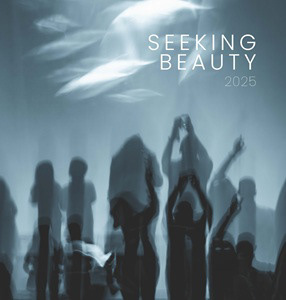
Here are excerpts from the current volume of Seeking Beauty, collecting my best photographs from 2025.
ACROSS THE GLOBE
Travel, for me, has become a reminder that the way we live is only one of many possibilities.
When my kids were young, I used to turn travel into a game. Once, I challenged them to compare our toilets with those we encountered abroad. In Japan, we marveled at toilets that washed your behind. In France, we laughed nervously at squat toilets, little more than a hole in the ground. What began as a playful curiosity slowly turned into deeper questions: Why do we assume our way is the best way? What might we learn if we allowed ourselves to see differently?
On the streets of Europe, we walked through downtowns closed to cars, felt the hum of trains arriving at all hours, and wondered at gas prices that made every mile precious. In those moments, the conversation shifted — from novelty to values. What does it say about a culture when walking is safer than driving? When trains are prioritized over highways? When a gallon of gas is a luxury, not a birthright?
More and more, I began to see how other societies organize themselves — their attention to public space, their willingness to share resources, their instinct to weave community into daily life. Returning home, the contrast stood out starkly. Our wide lanes and scattered suburbs suddenly seemed less inevitable and more like choices we had made — and kept making.
I don’t appreciate this country less for noticing these things. If anything, I care enough to ask: Could we choose differently? Could we imagine a way of living that feels both innovative and inclusive, bold and compassionate?
Travel has taught me that possibility is everywhere. Sometimes you just have to leave home to see it.
AROUND TOWN
I carry my camera everywhere I go. I never know when inspiration might strike — and when it does, I want to be ready.
Photography has made me more present. I notice light, angles, expressions, and reflections I might have missed if I were simply walking down the street. Without my camera, I wouldn’t have spoken to the bearded man sipping coffee in front of Colton Hall, the Kei truck owner proudly showing off her Daihatsu at the Concours d’Lemons, or the man slumped in his wheelchair at Plaza de César Chávez, gazing wistfully at the airplanes overhead.
As I’ve leaned further into creativity, San Jose’s suburbs sometimes leave me searching for their center. By contrast, the Monterey Peninsula feels steeped in character, as if the landscape itself remembers.
At Point Lobos, on the Pacific Grove seashore, in Carmel Valley and Big Sur, I sense the presence of the great photographers — Bullock, Weston, Adams, Ryuijie. Their images feel like echoes, nudging me to see differently. I imagine the pounding keys of Corona and Hermes typewriters, the tools of Steinbeck and Miller, their words woven into this same coast. Creativity lingers here, if you know how to listen.
Even San Francisco seems to be regaining its pulse. Photographing the Chinese New Year parade reminded me of the city’s electricity and diversity — so many cultures converging in one place. Walking its neighborhoods has deepened my appreciation for their character, each one beckoning me to explore further.
Photography has made all of this possible. Without it, I might have missed both the small details and the larger rhythms of the towns and cities I call home.
IN THE FOREST
Forests have a thing or two to teach us.
Visiting Big Basin State Park five years after the CZU Lightning Complex fire, I was struck by how alive the place felt. The redwoods were sprouting branches up and down their trunks, like fantastically tall pipe cleaners. Ferns, shrubs, and wildflowers greened the forest floor. Signs of animal life had returned.
Through that lens, I’ve been reflecting on my own life. I love having people around me, but I don’t want constant interaction. Sounds contradictory, right? I crave clarity in relationships — I hate having to guess or infer — and when conflicts arise, I deeply desire closure. When someone ghosts me, is it self-protection, or is it cowardice — a refusal to face what could be mended?
In the forest, nothing vanishes into silence. Fire comes, and life leans toward life — new shoots emerge from scorched and fallen trees, roots hold fast, the community continues. Walking through Big Basin felt less like mourning what was lost and more like witnessing a new beginning. The forest is unsentimental. It does what needs to be done — sprouting, rooting, enduring. Its resilience stirred an optimism in me that I hadn’t felt in years.
Perhaps the forest sets an example for all of us: commit to what’s good, cherish connection, and work to repair what is broken. And if something does burn to the ground — whether it’s a friendship or an acre in the mountains holding the tallest trees in the world — the task is the same: learn, grow, move forward.
DOWN BY THE OCEAN
These days, I chase sunsets with a camera in hand, sprinting toward the shoreline like it’s calling my name. But it wasn’t always that way.
Growing up in San Diego, the beach felt like an adversary, not a companion. I was self-conscious, half-blind without glasses or contacts, uneasy in the surf.
When we recently bought our home on the Monterey Peninsula, I felt ambivalent about living so close to the ocean. The old discomfort and quiet resentment toward the shoreline lingered, until I began exploring it on my own terms.
I started with walks along the trails of Asilomar, hopping from tidepool to tidepool, watching the tide gently undulate one day and violently crash against the rocks the next. Some mornings, the shore would be completely blanketed with fog. Other evenings, for just a few fleeting minutes, the setting sun would pierce through the clouds and bathe the shoreline in golden light.
In the fall, I’d marvel at pelicans gliding in perfect formation as they made their way south. In spring, sandpipers danced along Sunset Beach, skittering with the tide in search of plankton stirred up by the surf.
My return to the sea felt complete when we took a road trip up the Oregon Coast, marveling at sea stacks and pocket beaches along the way. In Fort Bragg, we combed the beach for blue, green, and white sea glass. In Bandon, we were lucky enough to witness Circles in the Sand during an unusually low tide — an experience that felt almost spiritual.
Now, I’m inexplicably drawn to the ocean, not the hot, sandy beaches of my childhood, but the moody, mercurial shoreline captured by Edward Weston and Wynn Bullock. The sea has become a companion, a muse, and a quiet source of renewal. I wouldn’t have it any other way.
IN MY HEAD
This past year has been a kind of crossing — not a sharp line, more like stepping off a highway onto a winding dirt road. The scenery is familiar, but the rhythm is different, slower, less certain.
Retirement — or the edge of it — has surprised me. I thought it would be a matter of time management, but instead it has been about identity. The scaffolding of colleagues and schedules fell away, and suddenly the days stretched out in ways that made me both restless and free.
Without those routines, I began to notice other absences: the easy camaraderie of work, the small reassurances of recognition, the sense of purpose built into a calendar. In their place came something quieter, harder to define — a need to rediscover where meaning comes from when it isn’t handed to you.
I’ve returned to photography, and in it I find both solitude and presence. Yet even that can leave me longing for connection. I’ve turned again to teaching, reshaping lessons so that students might see not only technique, but also possibility. I’ve even picked up golf — less for the sport than for the ritual of showing up, walking alongside others, learning to laugh at the wayward shots.
And yet, in quiet moments, questions linger: Does it matter if my photography finds an audience? Does a protest ripple beyond the day it is marched? Is relevance measured by the many, or by the few who are truly touched?
I don’t always know the answers. But I’m beginning to think the measure of this time is not in certainty, but in experimentation. A hike on a Tuesday. A road trip without destination. A class that sparks curiosity. An image that, for a moment, stills the world.
Perhaps this is the gift of the winding road: not knowing where it leads, but trusting that every turn offers something worth noticing.